Friday, May 15, 2009

Education: Anatomy, Physiology, and Pathology, Week 5

Pathology of the Integumentary System


Integumentary System Conditions


  1. Skin cancer


    • Carcinoma: cancer of the epithelial tissue


    1. Basal Cell Carcinoma: images


    2. Squamous Cell Carcinoma: images


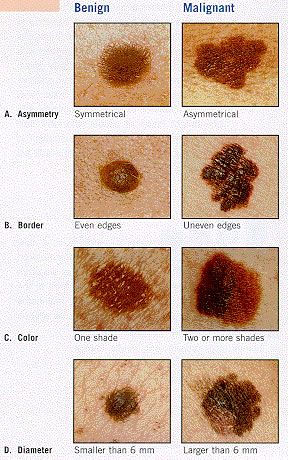
    3. Melanoma: images


    Basal cell carcinomaSquamous cell carcinomaMelanoma
    Cell Typeepithelial cells in basal layersquamous epithelial cells (keratinocytes)melanocytes
    Metastasis/Mortality rateLowest of these 3 typesNext lowest of these 3 typesHighest of these 3 types
    How common?Most common of these 3 types. The most common of all types of skin cancer; approximately 800,000 new cases yearly in US. Approximately 3 out of 10 Caucasians develop a basal cell cancer within their lifetime. Sunscreen protects.Next most common of these 3 types. Incidence of squamous cell carcinoma (SCC) varies with age, gender, race, geography, and genetics. The incidence of SCC increases with age and the peak incidence is usually around 66 years old. Males are affected with SCC at a ratio of 2:1 in comparison to females. Caucasians are more likely to be affected. Sunscreen protects.Least common of these 3 types. Sunscreen may not protect; this is currently being researched.
    Signs and symptomssore that does not heal, may be painless, may bleed, may itchsore that does not heal, may be painless, may bleed, may itchmole that exhibits ABCDs of melanoma: Asymmetrical skin lesion / Border of the lesion is irregular / Color: melanomas usually have multiple colors / Diameter: moles greater than 6 mm are more likely to be melanomas than smaller moles.


    Bacterial Conditions


  2. Acne: images


    1. Cause: hormone-related changes in sebaceous glands on the face, neck, chest, back, shoulders, combined with bacterial infection in inflammatory acne. Affects more than 85% of teenagers; can continue into adulthood.

    2. Signs and Symptoms: noninflammatory blackheads; inflammatory pustules (whiteheads). Severe acne can lead to scarring and/or psychological distress.

    3. Indications: No systemic reasons for people with acne to avoid massage.

    4. Contraindications: Avoid lesions.


  3. Impetigo: images


    1. Cause: bacterial skin infection

    2. Signs and Symptoms: rash, sometimes with blisters and/or crusts

    3. Indications: None

    4. Contraindications: Absolute; highly contagious. Do not massage until lesions have completely healed.


  4. Cellulitis: images


    1. Cause: bacterial skin infection that can go systemic

    2. Signs and Symptoms: redness, tenderness, fever, headache, malaise, systemic infection

    3. Indications: None.

    4. Contraindications: Absolute; do not massage until infection is completely cleared up.


    Viral Conditions


  5. Herpes simplex: images


    1. Cause: Herpes simplex virus

    2. Signs and Symptoms: Lesions: cold sores or fever blisters on face/mouth or genital region, tingling, itching, pain, blisters, secondary infection, psychological distress, social isolation

    3. Indications: Yes, unless there is any systemic infection (but use strict infection control precautions, such as washing hands, cleaning and bleaching surfaces and sheets)

    4. Contraindications: Lesions contagious; do not touch; do not touch objects that have come into contact with lesions.


  6. Chickenpox: images


    1. Cause: Varicella zoster virus, spread by (probably) respiratory route

    2. Signs and Symptoms: skin rash and blisters (dew drop) that breaks and crusts over, itching, respiratory symptoms

    3. Indications: Wait until client is fully recovered before massaging.

    4. Contraindications: Do not massage.


  7. Shingles (Herpes zoster): images


    1. Cause: Varicella zoster virus

    2. Signs and Symptoms: painful (often described as stinging, tingling, or throbbing) skin rash with blisters in a limited area on one side of the body along infected dermatomes.

    3. Indications: None--most people with shingles are in too much pain to tolerate massage well.

    4. Contraindications: Wait until lesions have healed and are no longer painful


  8. Wart (Verruca vulgaris): images


    1. Cause: Human papillomavirus (HPV) types 1, 2, and 3 (not the same HPV types as anogenital warts or cervical cancer).

    2. Signs and Symptoms: small rough tumor resembling a cauliflower or blister. They typically disappear after a few months, but can last for years and can recur.

    3. Indications: Ok to massage elsewhere than warts themselves.

    4. Contraindications: Local; practice strict infection control. Warts are contagious from skin of infected person, or from towels or other objects they have handled.


    Fungal Conditions


  9. Ringworm: images

  10. (notice that, despite the name, this is a fungus, not a true worm)


    1. Cause: Tinea: a general term for conditions where fungi overcome the body's resistance and establish an infection. Tinea capitis: scalp ringworm images; Tinea cruris: jock itch, "crotch rot" images; Tinea pedis: Athlete's foot images

    2. Symptoms: reddened circular itchy patches that can be spread by scratching. Athlete's foot can cause peeling of skin.

    3. Indications: Ok to massage unless systemic infection is present.

    4. Contraindications: Do not touch lesions; practice strict infection control, as lesions can be spread by scratching or by touching objects harboring the fungus.


    Parasitic Conditions


  11. Scabies: images


    1. Cause: parasitic mite

    2. Signs and symptoms: itching, burrowing, secondary infection, rash, secondary infection.

    3. Indications: none. Probably best to avoid massage because of major infection risk.

    4. Contraindications: Avoid infected area. Practice strict infection control.


    Miscellaneous Conditions


  12. Psoriasis: images


    1. Cause: autoimmune. Possibly a genetic component.

    2. Signs and Symptoms: affects the skin and joints, often elbows and knees. It commonly causes pink or red scaly patches to appear on the skin. Can have a huge impact on quality of life.

    3. Indications: Massage ok in subacute stages.

    4. Contraindications: Avoid lesions during acute stages.


  13. Scleroderma: images


    1. Cause: chronic autoimmune disorder

    2. Signs and Symptoms: hardening or sclerosis in the skin or other organs

    3. Indications: Massage as tolerated by patient, unless advanced circulatory or kidney damage is present. Scleroderma philanthropic organizations recommend massage for symptom relief and improved quality of life.

    4. Contraindications: Depends on patient; massage may be adapted to be less vigorous for more frail clients.


  14. Eczema: images


    1. Cause: The term eczema refers to a set of clinical characteristics. Eczema is a form of dermatitis, or inflammation of the epidermis. Classification of the underlying diseases has been haphazard and unsystematic, with many synonyms used to describe the same condition. Some cases of eczema can be caused by allergy.

    2. Signs and Symptoms: dryness and recurring skin rashes which are characterized by one or more of these symptoms: redness, skin edema (swelling), itching and dryness, crusting, flaking, blistering, cracking, oozing, or bleeding.

    3. Indications: Massage ok, depending on patient, as long as systemic inflammation is not present.

    4. Contraindications: Local.


  15. Decubitus ulcer, pressure sores, bedsores: images


    1. Cause: Pressure, especially of bony extremities, against surfaces, due to immobility, prolonged bed rest, paralysis, or other conditions that restrict motion.

    2. Signs and Symptoms: See descriptions/illustrations of Stages I-IV.

    3. Indications: Controversial. Some authorities say light massage is helpful for Stage I; all agree not to massage in later stages. There is a responsibility to report cases of neglect, and bedsores are a sentinel event (an event that triggers an alarm) of poor nursing care.

    4. Contraindications: Do not massage.


  16. Traumatic Burns

  17. It is generally accepted that a burn affecting more than one percent of the body surface, (approximately area of the casualty's palm) should be assessed by a medical practitioner.


    First-degree burnsSecond-degree burnsThird-degree burns
    Involved layers of skinEpidermis onlySuperficial (papillary) dermis; may also involve the deep (reticular) dermis layer.Epidermis is lost; damage to the subcutaneous tissue.
    CausesHeat, cold, electricity, chemicals, light, radiation, friction. Most sunburns can be included as first degree burns.Heat, cold, electricity, chemicals, light, radiation, friction.Heat, cold, electricity, chemicals, light, radiation, friction.
    Signs and symptomsRedness (erythema), a white plaque and minor pain at the site of injury.Erythema with superficial blistering of the skin; can involve more or less pain depending on the level of nerve involvement.Charring and extreme damage of the epidermis; sometimes hard eschar will be present. Scarring and loss of hair shafts and keratin. These burns may require grafting. Scarring and deformity may cause psychological distress.
    Healing time3-6 daysDepends on severity of burnDepends on severity of burn
    Massage indicated?Acute phase: No

    Subacute phase: Local contraindication, and to pain tolerance of client

    Chronic phase: Local contraindication, and to pain tolerance of client

    Acute phase: No

    Subacute phase: Local contraindication, and to pain tolerance of client

    Chronic phase: Local contraindication, and to pain tolerance of client

    Acute phase: No

    Subacute phase: Local contraindication, and to pain tolerance of client

    Chronic phase: Local contraindication, and to pain tolerance of client; possible treatment of scar tissue


Education: Anatomy, Physiology, and Pathology, Week 4

Content to be updated.

Anatomy and Physiology: The Integumentary System

Education: Anatomy, Physiology, and Pathology, Week 3

Content to be updated.

Pathology: Cellular Response to Trauma, Tissue Repair, Wound Healing

Education: Anatomy, Physiology, and Pathology, Week 2

Content to be updated.

Anatomy & Physiology: Cells and Membranes

Medical Terminology "N" through "Z"

Education: Anatomy, Physiology, and Pathology, Week 1

Content to be updated.

Introduction to Anatomy

Introduction to Physiology

Introduction to Pathology

Medical Terminology "A" through "M"

Sunday, April 12, 2009

MIRI Project: Massage for Injured Veterans of the Iraq and Afghanistan Wars

Executive Summary


This project is intended to provide low- or no-cost therapeutic massage to returning Iraq and Afghanistan veterans with post-traumatic stress disorder (PTSD) and/or traumatic brain injury (TBI) and/or spinal-cord injury (SCI), in order to address some of their treatment needs, as well as to assess the usefulness, effectiveness, and practicality of implementing a similar service program on a larger scale.

By providing therapeutic massage treatment for military veterans living with the physical and psychological after-effects of SCI, TBI, and PTSD, it serves people living with the after-effects of the tremendous sacrifices they were called upon to make. Additionally, by educating local massage therapists about the therapeutic needs of the veteran population, the effects of the service are magnified by training more providers who are able to deliver those services. Finally, by conducting research into what treatments these veterans find most effective in addressing their conditions, as well as into how this information can be most effectively relayed to other veterans and their care providers, it lays a foundation for lasting change in the way these services could be provided in the future.

Contact:

Massage for Injured Veterans of the Iraq and Afghanistan Wars

c/o Ravensara S. Travillian, PhD, LMP

PO Box 70523

Seattle, WA 98127

massage.for.injured.vets@gmail.com


Project Overview


Problem Statement


Veterans returning from Iraq and Afghanistan who are living with the effects of traumatic brain injury (TBI), spinal-cord injury (SCI) and post-traumatic stress disorder (PTSD) face a number of obstacles to receiving clinically appropriate, timely, and cost-effective treatment for their conditions. These obstacles include financial and bureaucratic hurdles, lack of available services, and the perceived stigma of dealing with mental-health professionals, among others.

Massage therapy has clear potential for addressing these problems. As therapeutic massage continues to become more integrated into mainstream medical practice, evidence is accumulating for its clinical effectiveness. It has been demonstrated to provide symptomatic relief for pain, anxiety, depression, muscle atrophy, and paralysis in other patients. For example, massage therapy has been used for treatment of PTSD in refugees in the Seattle area at Harborview Medical Center for years. While the therapeutic effects of massage cannot completely fill the gap between needs and treatment resources, results from other populations indicate that it may nevertheless provide significant benefits for returning injured veterans—especially if they suffer from any sort of chronic pain due to muscle or nerve trauma.

The project proposed in this document is intended to provide low- or no-cost therapeutic massage to returning Iraq and Afghanistan veterans with PTSD and/or TBI and/or SCI, in order to address some of their treatment needs, as well as to assess the usefulness, effectiveness, and practicality of implementing a similar service program on a larger scale.

Project Description


This project addresses the problem of the treatment gap for returning veterans with PTSD and TBI on three fronts: service, education, and research.

By providing therapeutic massage treatment for military veterans living with the physical and psychological after-effects of TBI, and PTSD, it serves people living with the after-effects of the tremendous sacrifices they were called upon to make. Additionally, by educating local massage therapists about the therapeutic needs of the veteran population, the effects of the service are magnified by training more providers who are able to deliver those services. Finally, by conducting research into what treatments these veterans find most effective in addressing their conditions, as well as into how this information can be most effectively relayed to other veterans and their care providers, it lays a foundation for lasting change in the way these services could be provided in the future.

Friday, March 20, 2009

Massage Informatics and Research Institute (MIRI), executive summary, version 0.1

The Massage Informatics and Research Institute (MIRI) is a planned Seattle-based organization, currently in the development stage, whose mission is intended to promote the following outreach goals:

Research

  • Exploring optimal ways of making massage research results available to practitioners worldwide, on an open-access basis

    • Example: mining existing research literature for massage-specific information, and publishing that research on the Web freely available to individuals, as well as to best practices efforts in massage professional organizations

    • Example: providing tools that permit experienced practitioners of massage the ability to generate and validate knowledge, as well as simple and user-friendly ways to share it with other practitioners on a large scale

    • Example: conducting original research into the mechanisms and clinical outcomes of massage, and disseminating that information with specific, user-friendly recommendations for clinical practice and indications for further research

  • Finding out how the diffusion and usage in practice of validated knowledge can be actively promoted among massage practitioners

    • Example: exploring innovative ways to use technology for communicating validated knowledge to visual and kinesthetic learners, as well as through traditional means developed for verbal learners

    • Example: generating new knowledge in massage by making it easy for practitioners to share their knowledge with each other on a large scale

  • Developing ways to counteract the disciplinary fragmentation of knowledge by integrating massage and established scientific disciplines into a truly holistic and rigorous massage science

    • Examples: developing and publishing validated, evidence-based knowledge repositories for the endocrinology of massage, the neuroanatomy of massage, and so forth


Education

  • Bringing the latest findings in anatomy, physiology, and pathology, and other relevant scientific disciplines to the local massage community

    • Example: making continuing education on massage science inexpensive, flexible, and convenient through the use of various formats, including occasional pro bono publico offerings. A recent offering, "Cross-Cultural Massage in Seattle: Ethiopian Communities" (Webpage accessed 22 March 2009), integrated case reports in massage among Ethiopian refugees and immigrants with the science behind the massage—anatomy, physiology, physical and cultural anthropology, and the pharmacognosy of Ethiopian medicinal plants.

  • Providing hands-on experiential learning in the natural sciences of biology, chemistry, physics, ecology and environmental science, and the social sciences of anthropology, sociology, psychology, and economics as they intersect and connect with massage

    • Examples: enhanced, life-long-experiential learning through the use of laboratories, field trips, and other participatory activities


Applied Research and Service

  • Providing massage for people living with the aftereffects of post-traumatic stress disorder (PTSD), traumatic brain injury (TBI), and spinal-cord injury (SCI)

    • Example: supervised preceptorships working with injured returning veterans

  • Providing outreach massage services for underserved populations in the Puget Sound area and in Washington State

    • Examples: supervised preceptorships and mentoring for working with refugee, low-income, and rural populations in various areas

  • Providing professional development for newly-graduated and experienced massage practitioners who wish to acquire, cultivate, and develop skills in research literacy and research capacity

    • Examples: critical thinking, reading a research study for applications in massage practice, designing a study, grant-writing


Core Values

MIRI centers all of its efforts on its diverse stakeholders, and is
grounded in the values of excellence, creativity, and democratization of access to high-quality scientific and biomedical information and healthcare. MIRI is committed to a team model of research and education, to pluralism, innovation, collaboration, and shared decision-making. A rapidly-changing society demands responsiveness; MIRI welcomes the challenge to be a part of that society’s emerging future by responding in a way that delivers quality and integrity in a flexible, nimble, and human-centered way. As a beneficiary to whom much has been given, MIRI recognizes its responsibility to pay this gift forward by increasing access to those who come along later—in this case by making the fruits of scientific and biomedical research much more widely accessible.

Mission

MIRI is a stakeholder-centered research, educational, and service institution, deeply committed to providing high-quality, validated scientific and biomedical information, and the means to generate and publish such information, to diverse communities. This mission includes increasing access to communities and participants who historically have not had as much access as others have had. Innovative promotion of life-long learning is an integral part of MIRI’s mission. As a solid partner in the community, MIRI takes very seriously its role in participating in economic, cultural, and social renewal, regionally and nationally, as well as globally.

MIRI is currently seeking partners in order to realize this vision, mission, and values. If you share these values, and are enthusiastic about transforming MIRI’s potential into reality, please contact Ravensara Travillian, PhD, LMP, at miri.scor@gmail.com for more information.